Discover Scuba in Phu Quoc: your first breaths underwater
Understand a first Phu Quoc scuba experience: preparation, Try Dive versus Discover Scuba, local programme examples, age, medical screening and flying afterwards.
Read next

PHU QUOC TOUR GUIDE
On a Phu Quoc dive, the interesting detail may be much smaller than the scene you imagined from the boat: movement among rocks, a fish holding its place, something nearly hidden against the reef. Give the first dive room for that kind of attention. It is also your chance to settle into the local boat routine, equipment and conditions before choosing a more demanding outing.
Book a certified-diver programme that matches your qualification, recent experience and the actual site. A fun dive is neither a first-time Discover Scuba session nor an automatic deep dive; the useful comparison is the water plan, support and complete boat day.
Send the centre your certification level, last dive, approximate logged experience and any equipment you want to rent.
These facts give the dive professional something useful to work with. “Certified” covers people who finished a course recently, regular divers and people returning after years away; they need different first sessions even when they hold the same card.
Start with a site and group that leave attention for buoyancy, weighting, communication and the exit. A busy photographic plan or the deepest advertised number is a poor substitute for that first local assessment. If you have been away from diving, discuss a refresher before choosing a normal excursion. The right first day can make the rest of the holiday much more enjoyable.
A certificate describes training, not familiarity with every sea. PADI’s usual adult Open Water training limit is 18 metres, while a Scuba Diver qualification has different supervision and depth conditions; junior qualifications have further restrictions. Give the centre the exact credential rather than assuming all cards permit the same itinerary.
Flipper’s site directory separates northern Turtle Island, Nudibranch Garden and Nail Island from southern sites including Mây Rút and Rỏi.
The names help locate the discussion, but the guide chooses the workable site for the group and conditions. A site directory is not a promise that a particular reef will be visited on your date.
Do not read “north” in a dive-site name as proof that it lies off northern Phu Quoc. Directories can name different sides of the same small island. Ask which departure area and site the centre means. Northern operations can use Dương Đông, while southern outings involve the An Thới side; that distinction also changes the road journey from your hotel.
Keep expectations focused on the reef rather than a guaranteed large-animal encounter. Small features, rock formations and the way fish use the habitat can reward a slower look. No current photograph establishes visibility, coral condition or wildlife for your departure. Choose a professional who explains the actual plan clearly rather than promising a particular animal.
Flipper’s current rendered page lists northern fun dives at 1,400,000 VND for one or 2,400,000 VND for two; southern examples are 1,800,000 and 2,400,000 VND.
It lists pickup, lunch, snacks and drinks. These are named programme examples, not a new booking offer from this guide. Its northern service states no diving from 10 May to 20 October.
Two dives need more than doubling the underwater minutes. There is preparation, a surface interval, another entry and equipment handling before the return. A person joining only to snorkel may have a different schedule aboard. Agree how the party is organised so one diver’s plan does not leave another guest without a worthwhile day.
For equipment, compare the actual rental arrangement: sizes, mask needs, exposure protection, computer and any camera handling. Familiar personal equipment can be useful, but it still has to fit the boat and dive plan. Do not infer a complete rental set or a private guide merely from a higher fare.
Put scuba earlier in the holiday rather than trying to fit it between checkout and a flight.
DAN’s symptom-free recreational guidance recommends minimum surface intervals of 12 hours after a single no-decompression dive and 18 hours after repetitive or multiday diving; longer intervals further reduce risk. Count from the final dive, and discuss the actual flight with the centre.
Symptoms that might indicate decompression illness require medical advice and avoiding flight, not a shorter calculation from a guidebook. A boat return time also says nothing about when you reach a northern hotel. Make the road transfer and evening realistic enough that the dive remains the main experience of the day.
Finish by recording the actual site and dive with your professional. That makes the next enquiry more useful than remembering only “two dives in Phu Quoc”. Good notes about conditions, equipment and what felt comfortable help you choose another local outing or continue training with a clearer starting point.
Understand a first Phu Quoc scuba experience: preparation, Try Dive versus Discover Scuba, local programme examples, age, medical screening and flying afterwards.
Compare Discover Scuba, Scuba Diver and Open Water in Phu Quoc. Understand course days, actual local prices, swimming skills, eLearning and certification.
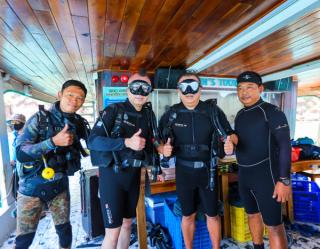
Compare Phu Quoc scuba programmes: introductory dives, certified-diver trips and courses, with named price examples, day structure and flying-after-diving planning.

Plan Phu Quoc tours around coast, wind and useful alternatives. Distinguish seasonal guidance, a marine decision, a changed itinerary and cancellation terms.
Yes, this format is for qualified divers. Choose Discover Scuba for a first supervised introduction.
Tell the centre when and where you trained so the first local site and group suit your experience. Qualification is the starting point, not a demand for the hardest site.
No. The site and plan must fit training, recent experience, conditions and any junior restrictions.
Discuss what you will bring and what remains rented, including sizes and computer arrangements, before the boat day.
The named operator has a seasonal closure. Other operators require their own operating information; one calendar is not an island-wide rule.
No. The preflight interval runs from the final dive and depends on the dive profile. Plan it with the centre and follow qualified medical guidance if there are symptoms.