
Nature Tours in Phu Quoc: River Paddles, Forest Paths and Stream Days
Choose a Phu Quoc nature tour by landscape and route: Cua Can kayaking, northern forest, Ham Ninh hills and seasonal streams, with realistic day plans.
Read next

PHU QUOC TOUR GUIDE
Phú Quốc’s forest changes the way you notice the island. Instead of a long view over water, there are roots underfoot, fungi on fallen wood and birds you may hear without seeing. Our trekking originals are at their best in those small observations. They also name several very different outings, from Tiên Sơn Đỉnh near Hàm Ninh to short forest and stream walks. Choosing the right one starts with the route, not with the promise that every walk leads to a summit.
Choose a named guided route whose ascent, descent, walking time and access are explained. Tiên Sơn Đỉnh is a mountain outing near Hàm Ninh; a northern forest-bath stop is a shorter experience with a different purpose. A drive through the National Park is scenery from a road, not a guided trek.
Tiên Sơn Đỉnh belongs in a conversation about a mountain walk, with effort on both the climb and descent.
Suối Tranh and Đá Bàn belong in a different conversation about a stream outing and the time spent beside water. Neither a stream name nor the phrase National Park tells you the route length, gradient or whether the visit includes a sustained forest walk.
Our originals mention Núi Chúa separately from Tiên Sơn Đỉnh. Do not merge the names into a single highest-peak itinerary or assume a scenic road is an entrance to a summit. The route should have its own start, turnaround or finish and return plan. When the organiser cannot distinguish those, the mountain name is doing more work than the itinerary.
A shorter guided walk is a good choice in its own right. It can give time to notice the forest rather than count metres gained. Choose that deliberately if the group wants shade, natural detail and a modest outing. There is no need to call it a mountain expedition to make it worthwhile, and no reason to judge it by whether everyone reaches a viewpoint.
Ask for actual walking time as well as the door-to-door tour duration.
A six-hour excursion may include a long vehicle transfer, a meal and several non-walking stops. For the walking part, the useful details are the ascent and descent, surface underfoot, exposed sections, rest places and whether the route returns the same way. Those answers help you compare two guides far better than the word moderate.
Give the guide concrete information about your party: recent walking experience, trouble with steep descents, a knee that dislikes high steps or a child who has only walked paved paths. This is more useful than calling everyone reasonably fit. A person may handle a long flat walk well and still find a short root-covered descent demanding.
Agree on the point at which the group turns back or changes the plan. A smaller goal reached with enough energy for the descent is better than reaching a viewpoint late and rushing down. A guide earns value through route judgement and interpretation, not just by walking ahead with the fastest people. The forest story should remain available to the whole party.
Saigon–Phu Quoc Resort publishes a mountain-and-stream outing dated 3 April 2025: hotel pickup at 08:30, walking from 09:00, descent at 10:45, Suối Tranh at 11:30 and hotel return at 13:00.
It lists a guide, vehicle, water and stream admission. It is a useful published example, not a current fare or a measured trail specification.
The resort’s attached tariff lists 805,000 VND per person for four guests: 3,220,000 VND for the party. This published example is not a universal trekking fee. For Tiên Sơn Đỉnh, book the actual guided route rather than treating the mountain name as one standard attraction ticket. The meeting point, included transport, food, water and length of the walk should travel together in the itinerary. A price with hotel pickup and lunch cannot be compared directly with a guide-only fee at the trailhead. Have the return vehicle planned before the ascent, especially when the walk finishes away from the start.
The resort outline gives the morning a coherent shape: a climb, time above the trees, a descent and a separate stream visit. Keep those activities distinct when comparing an alternative. A brief look at a stream should not be counted as several more hours of trekking, while a longer summit route needs more time than this particular morning example allows. If lunch in Hàm Ninh is part of your own plan, finish the walk before turning it into a restaurant outing; the shoreline is a separate stop, not the mountain trailhead.
Rain makes a forest walk visually rich, but wet roots and rock change the descent.
A stream may have more water when the approach is also harder. Conversely, an easy dry approach does not guarantee a flowing waterfall. Choose the walk for the landscape you want and the footing you can manage, rather than treating rainy season as either always bad or automatically the best time.
Use shoes with grip that you have already walked in, a small pack, water and light clothing that can dry. Keep a dry layer for the vehicle journey rather than carrying a heavy change for every possible photograph. A walking pole is useful only if you can use it comfortably and the route permits it; it does not replace a route suitable for your knees.
Keep hands free on uneven ground. Stop before taking a photograph, leave fungi and plants where they grow and let animals remain unhandled. Our originals invite attention to small details, not collecting them. Birdsong, a changing patch of light and the shape of a root can make a walk memorable even when the canopy never opens into a broad sea view.
Choose a Phu Quoc nature tour by landscape and route: Cua Can kayaking, northern forest, Ham Ninh hills and seasonal streams, with realistic day plans.
Choose between a short beach kayak, a guided northern-coast paddle and Cửa Cạn river kayaking, with a named programme and practical route questions.
Choose a northern Phu Quoc tour around Cửa Cạn, forest scenery, Rạch Vẹm or Gành Dầu. Understand the real route, seasonal Hàm Rồng stop and Grand World return.
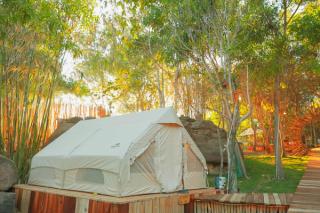
Compare Mây Rút Trong camping with furnished Hòn Xưởng glamping: sleeping arrangements, shared facilities, meals and the complete two-day journey.
Separate the walking stages from hotel transfers, meals and any stream or sightseeing stop. A mountain programme should give time for the ascent, rests and descent; the total excursion duration alone cannot tell you the physical effort.
Do not treat the names as interchangeable. Our originals discuss them separately. Use the guide’s exact named route and access plan rather than a generic highest-peak claim.
Very little without distance, ascent, descent and surface details. Describe your recent walking and any difficulty with steps or downhill sections so the guide can match an actual route.
Separate the guide, hotel transfers, food, water and any access costs. Obtain the actual meeting point and return arrangement with the route. A guide-only fee at the start is a different purchase from a complete hotel-to-hotel outing.
No. A stream visit can be a pleasant shorter outing, but it does not establish a summit climb or several hours of trekking. A combined programme should show how much time belongs to the ascent, descent and separate stream stop.
Water, appropriate sun and insect protection, a phone kept dry and any personal essentials. Wear tested shoes with grip. Keep the load light enough for the descent, and agree with the guide what food and water are supplied.