
For a ready-arranged nhà bè meal and coastal boat product, Rạch Vẹm currently has clearer visitor services.
Phu Quoc areas
Rạch Tràm: the northern river, forest edge and fishing settlement
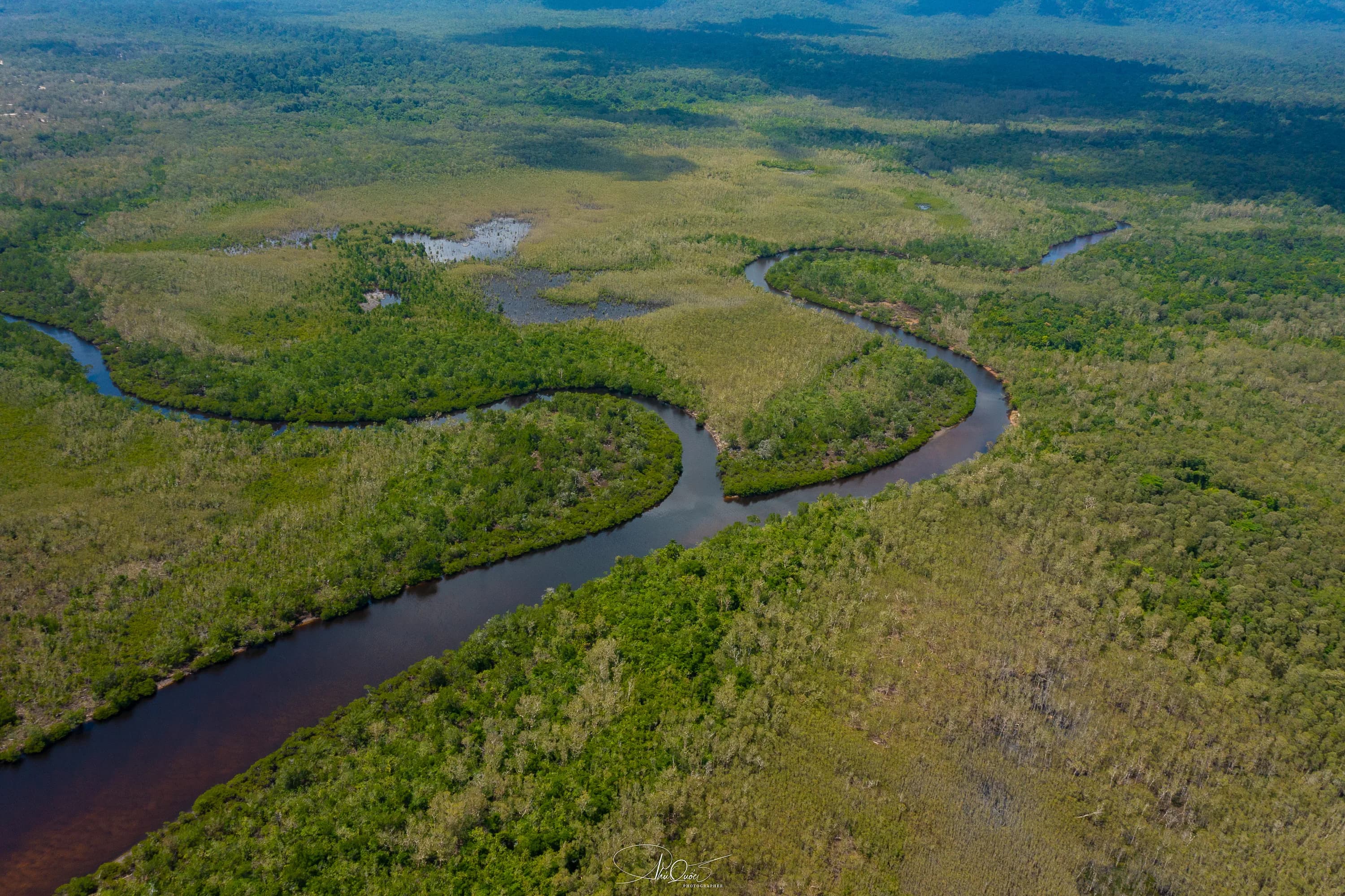
At Rạch Tràm, the interesting part of the river is often its edge: roots meeting the water, small crabs on a muddy bank and woodland rising behind the tidal trees. Our mangrove reporting brings the eye down to these details. This northern fishing settlement offers a different Phu Quoc from the island’s resort strips, with forest, river and working coast in the same landscape.
Does this area fit your trip?
Reach Rạch Tràm from the ĐT.973 north–south road via ĐH.86, the road towards the Rạch Tràm settlement. Come for the fishing village, river-mouth landscape and contrasting forest banks. A village visit works without a water activity; for the protected river and forest, start with the National Park’s general information contact.
The National Park contact below is for access information, not a confirmed boat operator. No public Rạch Tràm SUP desk, fixed river departure or current tour tariff is advertised here.
Location on the island
A river landscape in the northern part of the island
Rạch Tràm is the northern fishing settlement and river landscape in the wider Bãi Thơm region.
Map of Rach Tram
Enable Google Maps to explore the map here. Google receives connection information when the map loads.
Enables maps only. Your analytics and advertising choice stays unchanged.
Search by area name; this does not define a boundary or exact entrance.
Open in Google MapsArea orientation
Rach Tram
It is separate from Rạch Vẹm’s seafood platforms and Hàm Rồng boats. For road navigation, distinguish three destinations: the residential village, the shore by the river mouth and an excursion farther into the forested river. A village pin gets you to the first of these, not automatically to a boat launch. Start with the settlement as your land destination, then choose how much of the coast and river you want to explore. This makes a visit possible without building the entire day around an unconfirmed water activity.
Choose it for the landscape itself
Rạch Tràm suits an intentional river-and-village day.
Two different banks, one river
The two banks are not a uniform wall of mangrove.
Nhân Dân’s March 2024 photo report describes tràm mixed with taller dầu and sao trees on one side, with mangrove vegetation on the other. That meeting of woodland and tidal forest is the river’s distinctive feature. Our original mangrove article adds the smaller scale: roots along the waterline, birds around the trees and crabs moving across muddy banks. These are things to look for, rather than a promised wildlife encounter. Look at the bank as well as the reflection; the forest changes character across the river.
A real contact for protected-river access information
For questions about visiting the protected river and forest, Phu Quoc National Park publishes the general phone 0297 868 2555 and email vqgpq@angiang.gov.vn.
Its headquarters is in Xóm Mới; do not confuse that office with a Rạch Tràm boat launch. Ask whether a visitor route is currently available, who receives visitors and where the start and finish are. The park can be approached for information; this guide does not claim it sells a river trip. If a local outing is offered, settle the boat or board, host, return point, duration and total group price together. A price per boat is different from a price per person, and a village car journey does not include either.
Look for roots, reflections and the muddy edge
A useful way to read this landscape is to move between two scales.
First take in the curve of the waterway and the taller trees behind it; then notice the tangle at the waterline and the exposed muddy margin. Our mangrove reporting describes small crabs there and birds around the forest. A longer lens lets you watch without crowding them. Photograph from the bank or your arranged boat, leaving roots and soft mud undisturbed. Rain also changes the water’s colour, so the river need not match the bright green of a particular photograph to be worth looking at.
A village visit first; river time only when arranged
For a first visit, make the village and the coast the core of the morning.
Arrive by the ĐH.86 approach, meet your local contact if you have one, and spend time with the working shoreline before adding any river excursion. Our original transport article makes a useful northern-island observation: finding an outward ride is often easier than finding the next available car home. Keep your driver for the outing, or save their phone and agree the return time before they leave. Carry drinking water and a simple snack. For a sit-down meal, either arrange cooking with the person receiving you or return to a restaurant already chosen on your route; a fishing settlement is not automatically a walk-in seafood restaurant.
Rạch Tràm and Cửa Cạn tell different river stories
Our original mangrove feature places Rạch Tràm beside Cửa Cạn as two ways to understand this side of Phu Quoc.
Cửa Cạn belongs to the western village-and-river geography; Rạch Tràm takes the story farther north, towards forest and fishing coast. They do not need to become a two-river day. Pick the region you want to explore, then give its trees, settlement and shoreline enough time. Rạch Tràm is especially interesting when your purpose is to observe the transition between woodland and mangrove, rather than find a succession of ticketed attractions.
The road in: ĐT.973, then ĐH.86 towards the settlement
From the Dương Đông side, use Nguyễn Trung Trực and the north–south ĐT.973 corridor towards Bãi Thơm.
The provincial road register identifies the Rạch Tràm branch as ĐH.86, running from ĐT.973 at the Bãi Thơm ranger-station landmark towards the Rạch Tràm resettlement area. That gives a driver a specific road to work with instead of a vague northern beach pin. The ranger station is a route landmark, not a public tourist ticket office. Use the village as your drop-off and agree a shore meeting point locally. Road names establish the approach; they do not describe the condition of every last lane.
What to settle before leaving Dương Đông
Save the village destination and return-driver contact.
If the river is essential, obtain the receiving person and launch before setting out; otherwise keep a land-based village visit and an already chosen meal as the plan.
Related areas
Consider another area
Consider Rach Vem, Bai Thom. Compare the journeys you would repeat and how you want to spend your evenings before choosing.

Rach Vem
Before the starfish photographs, there is a village: boats moving through the bay, nets by the shore and wooden walkways leading towards lunch over the water.
Open guide
Bai Thom
Bãi Thơm is a change of direction as much as a change of beach.
Open guide
Continue planning
Move from the area to your next decision
Once you have chosen the area, use the guide that matches what you still need to arrange: Plan how to get around.

Questions about Rach Tram
What is Rạch Tràm known for?
Its northern river landscape, forest edge and fishing settlement. The contrast between woodland and mangrove banks gives the river its particular character.
Is it the same as Rạch Vẹm?
No. Rạch Vẹm is the village-and-nhà-bè outing associated with Hàm Rồng boats. Rạch Tràm is a separate northern river destination.
Who can I ask about visiting the protected river?
Phu Quoc National Park lists 0297 868 2555 and vqgpq@angiang.gov.vn for general enquiries. Ask about the available route and receiving contact. This is not a confirmed river-tour booking desk.
What should I look for beside the water?
Look at the contrast between the taller woodland and mangrove banks, then the roots, reflections and muddy margins. Our original reporting describes crabs and birds here; sightings vary.
How do I reach the village by road?
Use the ĐT.973 corridor, then the ĐH.86 Rạch Tràm road towards the settlement. The Bãi Thơm ranger station is the road-register landmark, not a visitor reception desk.
Can I rely on calling a car only when I want to leave?
Our northern-island transport reporting describes sparse available drivers here. Arrange the return with your outbound driver and save the phone number, or keep a private car for the outing.