
fish sauce
Fish sauce
Buy Phu Quoc fish sauce for dipping or cooking: understand nitrogen degrees, bottle sizes, producer addresses, protected origin and a specific airline packing rule.
- Price unit
- By bottle and volume
Open buying guide


SHOPPING · LOCAL PRODUCTS
Grilled squid gives the evening market its smoky edge. Pepper makes a small dish of dipping salt fragrant. Fish sauce carries a much deeper, saltier flavour into the meal. These are useful memories to bring home because they can become another dinner, rather than another object waiting on a shelf. Start with the flavour and the person who will use it.
A group listening to a guide beside wooden barrels
FIVE GIFT FORMATS
From pepper for the kitchen to a keepsake for the home, choose a gift and explore how to buy and use it.
fish sauce
Buy Phu Quoc fish sauce for dipping or cooking: understand nitrogen degrees, bottle sizes, producer addresses, protected origin and a specific airline packing rule.
pepper
Choose Phu Quoc pepper by processing and use: whole or ground, black, red, white or green, plus a named farm shop, net-weight comparisons and storage.

sim wine
Choose Phu Quoc sim wine, syrup or sweets by taste and use. Compare labelled alcohol levels, bottle sizes, tasting samples and practical gift formats.
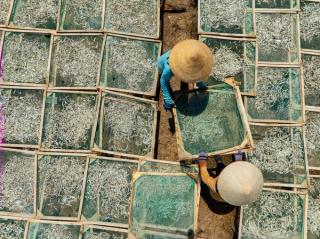
dried seafood
Choose Phu Quoc dried seafood for real meals: compare squid, one-sun squid, shrimp, anchovies and prepared snacks by storage, edible weight and intended use.

handicrafts
Choose Phu Quoc keepsakes with a useful purpose: textiles, art and small objects, maker and material questions, condition checks and responsible souvenir choices.
Whole dried pepper is a compact pantry gift; fish sauce is a kitchen staple with a liquid-packing job. Sim syrup, wine and sweets serve different recipients. Fully dried seafood and one-sun squid require different storage. Choose the product first, then use its buying guide for the details.
Reviewed:
For a friend who cooks, a modest packet of whole pepper can offer more than a large mixed souvenir box.
For a family that uses fish sauce every day, a familiar bottle size may be better than a decorative ceramic container. Someone without a kitchen may prefer a ready-to-eat product. Ask what will happen to the gift after the trip, rather than choosing only what looks most impressive in the shop.
Tasting helps with flavour, provided you can identify the product afterwards. Ask which pepper, fish-sauce grade or sim drink you tasted and match it to the sealed pack. A sample prepared as a dip can include salt, sugar or other ingredients; that flavour is not necessarily the single ingredient sold beside it. Buy the recipe or the ingredient knowingly.
Keep the first shopping list small: one product for home, one for a person you know will use it. Add more only when the format works. This makes it easier to compare actual ingredients, sizes and prices without turning the last afternoon into a hunt for gifts bought simply to fill a bag.
Pepper is the simplest of these formats to portion into several gifts: choose sealed dry packs rather than one large opened bag divided without labels.
Whole pepper suits a grinder or mortar; ground pepper is ready for a kitchen without either. Fresh green clusters and brined pepper are different products from dry peppercorns, with their own storage and transport needs.
Fish sauce connects the gift to the island’s anchovy-fermentation craft. Choose the volume the recipient will use and the container that fits the journey. Sim needs another choice first: syrup for mixing, a labelled alcoholic drink, or a sweet. A purple bottle does not tell you whether its contents are suitable for somebody who avoids alcohol.
Dried squid, dried shrimp and anchovies belong in different home meals. Mực một nắng retains moisture and is usually bought as a cold-chain product, not a dry souvenir for days in a suitcase. If the recipient cannot store or prepare it, choose another format. A product does not become a better gift merely because it is the most famous one at the stall.
A barrel house or pepper garden can explain why an ingredient matters here.
It gives the purchase a context: fermentation time, a vine’s berries, the difference between a crop and a finished seasoning. The shelf still needs its own product description. Ask what was grown or made there and what was brought in, especially when the shop sells several unrelated gift categories.
For named starting points, Khải Hoàn publishes two Dương Đông addresses: its specialty-shopping centre at 289 Đường 30/4 and traditional fish-sauce store at 11 Hùng Vương. In the north, the Grand World operator directory lists a Khải Hoàn shop at HH-157 in the Indochine district. Choose the actual branch rather than assuming every point includes a working barrel-house tour.
A supermarket works well when you want several labelled products in one errand. The Shopping hub and Supermarkets guide locate central-west and Grand World options. A working market is useful for ingredients and everyday trade; an evening visitor market is more naturally a food-and-browsing stop. Choose the setting for what you need to buy or see.
Net weight and product type make prices comparable.
As a hypothetical calculation, 100 g of pepper at 50,000 VND equals 500,000 VND/kg; a 250 g pack at 100,000 VND equals 400,000 VND/kg. That arithmetic does not establish that the larger pack tastes better. First make sure both contain the same kind of pepper, rather than whole berries in one and a salt blend in the other.
A mixed box can be useful when you want small samples, but read each item’s quantity. Packaging, glass and decorative containers add weight without adding more edible product. If buying for several households, separate sealed packs can be easier to share than one elaborate set. Keep the original labels with the recipients so storage and use remain clear.
Pearls and non-food keepsakes have their own guides because their value is not measured like a pantry ingredient. A piece of jewellery needs a material and item description; a craft object needs a maker and material where those are part of its appeal. Do not apply a food-market bargain method to a valuable object with a very different purchase decision.
Make storage the first packing question for seafood, leak containment the first for a liquid, and impact protection the first for glass.
These jobs are separate. A vacuum bag does not create refrigeration; a padded gift box does not necessarily contain a leak. Ask the producer for directions for the actual product, keeping its sealed labelled pack intact.
For a flight, check the carrier before choosing a bottle or cold product that may be difficult to transport. International food-entry rules are another decision belonging to the destination. If the route makes a favourite product impractical, enjoy it on the island and take home a format that fits. The specialist guides separate those choices without making every souvenir into a complicated purchase.
A sealed dry pepper pack is compact for somebody who cooks. Choose whole pepper if they have a grinder or mortar, ground if they prefer ready-to-use seasoning.
No. They are different product types. Choose the labelled drink or syrup for its intended use and read the alcohol declaration.
It retains moisture and commonly needs cold storage. Follow the producer’s instructions; do not treat vacuum packing as a substitute for refrigeration.
289 Đường 30/4 for its specialty-shopping centre and 11 Hùng Vương for its traditional fish-sauce store. A retail address does not automatically include a production visit.
No. Read the maker, production location and product information. Neither rustic nor glossy packaging is an authenticity test.
Only if its actual contents suit the recipients. Several smaller sealed packs can be easier to distribute, store and carry.